


Book Reports.
Below are five book reports. Well, sort of.
They’re books I care about, or at least books with personal stories attached to them. If you were expecting me to write serious critiques, I should remind you that I’m poorly educated and pretty lazy.
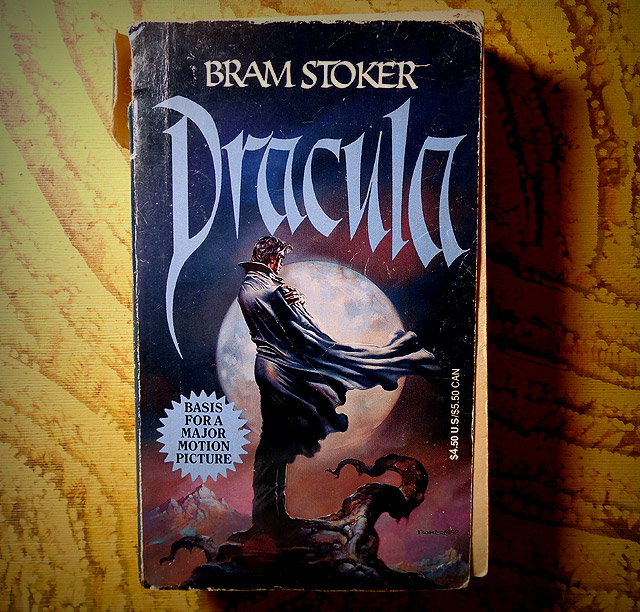
Dracula, by Bram Stoker (1897)
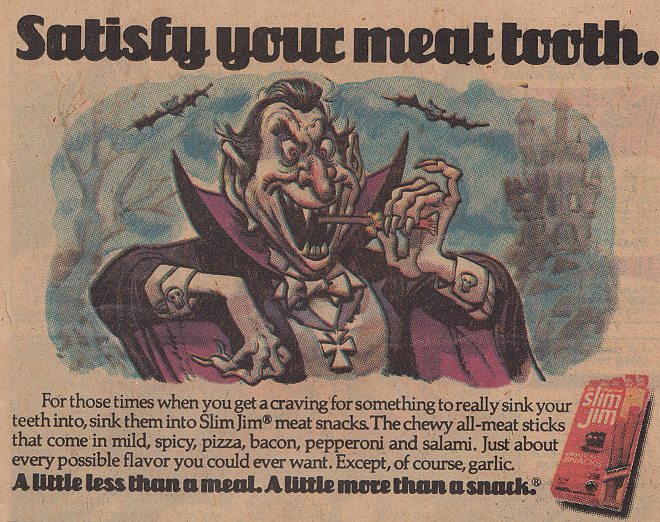
Bram Stoker’s Dracula (the film, I mean) came out in November of ’92, signaling an interest boost in All Things Dracula. I was in the eighth grade at the time, and I picked this baby up from my junior high’s book fair.
I was going through my “depression phase,” phoning it in with all-black outfits and a bad haircut. It had as much to do with fashion as feelings, but it’s also true that I felt like a goofy nobody. Going “mock goth” at least made it seem intentional.
I didn’t buy this book to read it. I bought it as an accessory. Something to casually leave on my desk during class. Hey, only the deepest kid in school would carry around a Dracula book! Yes, I imagined my fellow students viewing me with great intrigue! Dracula cost $4.50 at that book fair, and it seemed like a small price to pay to be fucking interesting for once.
I can laugh about this now, because even if I never outgrew misfitdom, it’s not like I really wish I had. At the same time, those memories mean that I’ll never stop having empathy for dorks. I believe we can find the best opportunities to build ourselves when we’re at our most hopeless, but you can only appreciate that kind of silver lining in retrospect.
So, if Dino Drac has any especially young readers on the fringe: You’re reading a guy who once believed he’d become popular by pretending to read Dracula. In the end, you’ll be fine.
You’ll be almost fine.
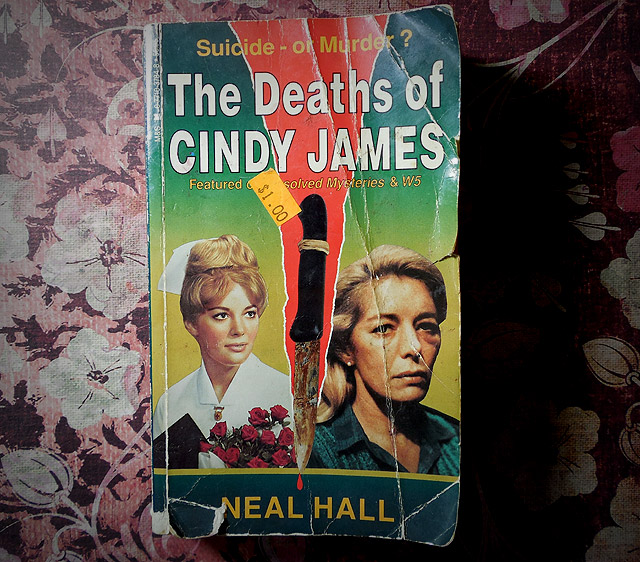
The Deaths of Cindy James, by Neal Hall (1991)
Notice the wear-and-tear? It’s because I’ve read this book over a hundred times. And that’s a very conservative estimate.
I learned about Cindy James on an Unsolved Mysteries segment. She was a divorced nurse who was brutally murdered after years of incidents involving an unknown assailant. At least, that’s how it seemed on the surface, if you hadn’t heard the whole story.
Unsolved Mysteries stayed pretty neutral, but the other theory – the one based more on facts than feelings – is that Cindy staged all of her previous “attacks,” ultimately committing an elaborate suicide.
I became obsessed with this case. Hell, I’m still obsessed with it. You’ll find tons of information about it online, but nothing compares to the books. (There were two, but this is the better one.) No matter which theory you end up subscribing to, the story is absolutely creepy. It’ll seem weird to say, but the things that happened in Cindy’s final years were even scarier than her ultimate death. (In fact, they’re all the more unsettling if you imagine Cindy doing it, whether purely for the attention, or because she – as some have speculated – suffered from Multiple Personality Disorder.
Scouring the Internet will get you the broad strokes, but if you want the whole story without the thousand uninformed opinions from people who only saw the Unsolved Mysteries episode, find this book!
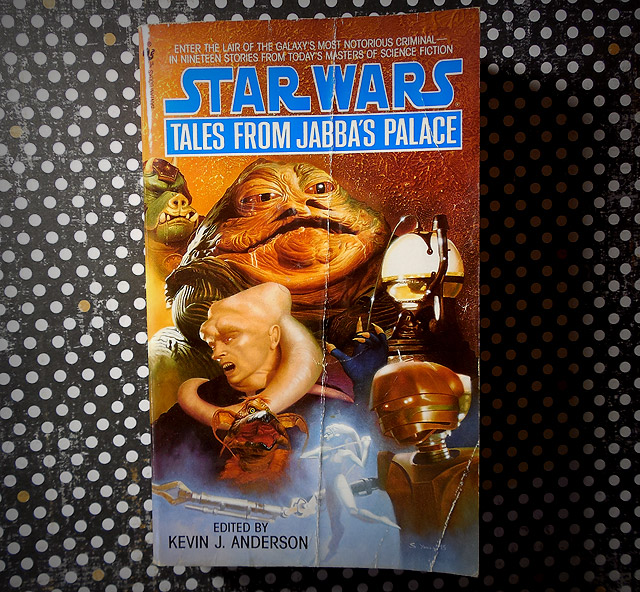
Tales from Jabba’s Palace, edited by Kevin J. Anderson (1995)
Disney takeover and future plans aside, these last few years have been pretty rough for Star Wars fans. Maybe it’s just me, but I feel like there’s been a big shift in how “outsiders” view the franchise. We fans have gone from deflecting nitpickers to defending our very right to like it.
If you don’t get the “Star Wars thing” because you didn’t like the movies, I think this book helps illustrate what it’s really about. Whatever flaws the films may have had, they created an awesome and basically endless universe, filled with unbelievable things of every conceivable type. No matter what you think of the filmmakers’ talents, that universe has since been exploited by too many talented people and in way too many ways for anyone to ever write the whole thing off as “garbage.”
Star Wars fans love the movies. Of course we do. But it goes so far beyond that.
Take this book. Tales from Jabba’s Palace. Each chapter is about a different character from Jabba’s dank abode, as seen in Return of the Jedi. All of the major “aliens” you saw in the film – the ones who barely had two lines, and the ones who had no lines at all – finally get a chance to tell their stories.
The chapters and characters are handled by different authors, but the book still has consistent threads. Even if it isn’t a hundred percent canonical, it doesn’t interfere with anything that happened in the movie. The various plots work around the film, beautifully.
One of the chapters is about Oola, Jabba’s “original” slave girl. Remember their little tiff before Jabba kicked her to Rancorland? The book explains that tiff and gives it so much more meaning than the film did. Tales from Jabba’s Palace is full of that. It makes kickass mountains out of the smallest molehills.
This book is just one of a thousand things I could name to better explain fans’ fascination with Star Wars. Really, at this stage, I mainly view the movies as a “style guide” that set the tone for so many other things that I’ve become even more interested in.
Also: If you’re a Star Wars fan who never really went beyond the movies and possibly a few video games, Tales from Jabba’s Palace could not be a more perfect introduction to the “expanded” universe.
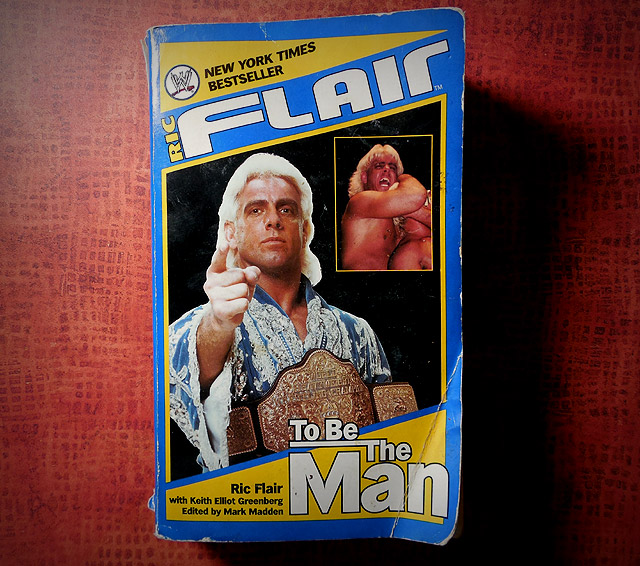
To Be The Man, by Ric Flair and other people who are not Ric Flair (2004)
I’m such a sucker for wrestler autobiographies. They’re my weakness!
I’ve read all of the big ones, and I’m wholly convinced that it takes a MIRACLE for a wrestler to escape his book without looking bad. No matter what you think of pro-wrestling, these guys are passionate and absurdly driven performers, in a huge business that exists in a very small world. Emotions naturally run high, and unfortunately, these books often exist as much as for defenses and indictments as they do for fun stories about life on the road.
I don’t know how much of Ric Flair’s book was “editorialized,” but it’s no different. There are so many great stories and true feelings in here, but they’re easy to miss when surrounded by blanket praise for the provider of the paychecks, and blanket scorn toward everyone Flair had axes to grind with at that exact moment. This certainly isn’t exclusive to his book. Many times, I’ll read these things and wonder if the opinions inside wouldn’t have been entirely different had the books been published, oh, six months later.
Of course, I’m focusing on the negatives. Once you cut through the bullshit, the best of the wrestler autobiographies are just plain gripping. In some ways, the warts only add to them.
Even if you care nothing for pro-wrestling, you have to admire the sacrifices these athletes make do so something that ends well for approximately .0005% of ’em. Most of us will never love anything that much.
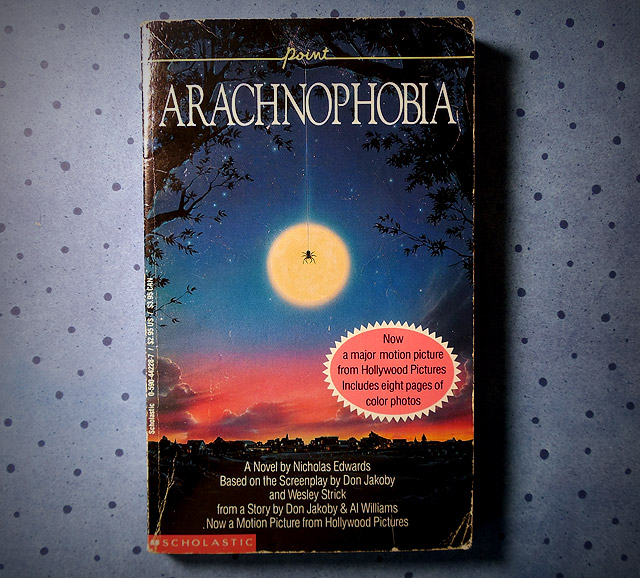
Arachnophobia, by Nicholas Edwards (1990)
This is just a catch-all shout-out to movie novelizations. I freakin’ love the things. I own tons of them, and many are based on unbelievably “small” movies. I don’t envy the author who had to turn Jaws: The Revenge into a 400-page tome, but somehow, someone did.
This Arachnophobia novel is much shorter by comparison, and fairly by the numbers. It just turns the movie into a novel, though I suppose that’s all a “novelization” is really supposed to do. On the bright side, it has the always-welcome eight-page photo spread in the middle. Ditzy novelizations really aren’t complete without them.
But the best of these books do so much more. A good example is the Gremlins novel. I haven’t read it since I was a kid, but I still remember it so clearly. The author went inside the minds of the mogwais, turning Gizmo and Stripe’s strife into a ballsy, creepy, extremely dark thing. I already knew that Stripe spat at Gizmo, but now it had subtext.
These novels aren’t always written by hacks. Actually, most aren’t. Many are penned by hungry and capable authors who won’t let the fact that their first big gigs are “this” keep them from bringing their A-game. If you’ve ever stopped short of buying one because “who needs book when I have movie,” please reconsider. On their best days, these novelizations pitch us our favorite films as if they’re eight hours long and with limitless budgets.
Plus, neat photos in the middle!